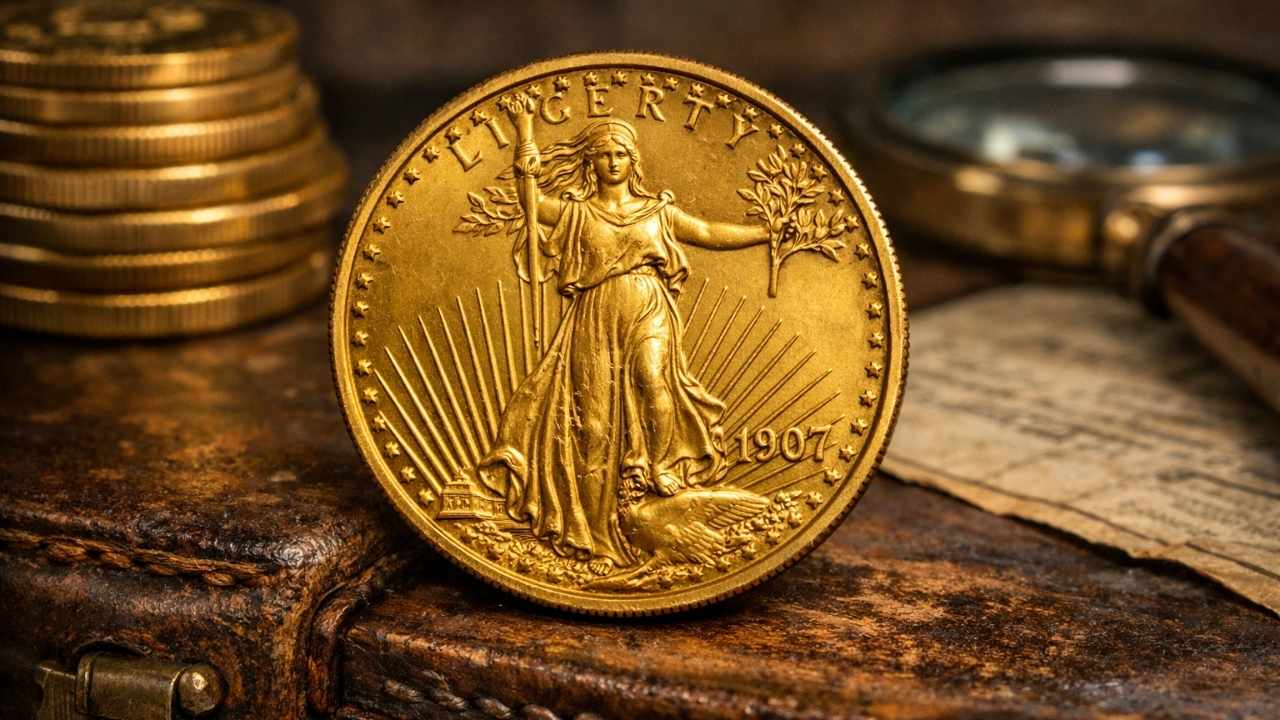
1907 Saint‑Gaudens Double Eagle Rumored at $1.2B: The Saint Gaudens Double Eagle is often hailed as the most beautiful coin ever minted in the United States. Designed by Augustus Saint Gaudens at the request of President Theodore Roosevelt, this twenty dollar gold coin was introduced in 1907 and quickly became a symbol of artistry, liberty, and national pride. Over the years, it has captured the imagination of collectors worldwide, and rumors of a specimen valued at $1.2 billion have only added to its mystique.
Roosevelt’s Vision for American Coinage
At the turn of the twentieth century, President Roosevelt believed that American coinage lacked artistic merit. He wanted coins that reflected the grandeur of ancient civilizations and the ideals of liberty. To achieve this, he enlisted Augustus Saint Gaudens, one of the most celebrated sculptors of the era. The result was the Double Eagle, a coin that combined classical beauty with bold symbolism.
The obverse depicts Lady Liberty striding forward with a torch in one hand and an olive branch in the other, symbolizing enlightenment and peace. The reverse features a powerful eagle soaring into the sunrise, representing America’s rise to greatness. This design was revolutionary, setting a new standard for coinage artistry.
The 1907 High Relief and Ultra High Relief Issues
The 1907 Double Eagle was struck in both high relief and ultra high relief versions. The high relief coins were produced in limited numbers before the design was modified for practicality. The ultra high relief coins, however, were experimental pieces, struck in extremely small quantities. Only a handful are known to exist today, making them among the rarest coins in American history.
The ultra high relief coins are considered masterpieces of numismatic art. Their intricate details and sculptural quality reflect Saint Gaudens’ original vision in its purest form. Collectors prize them not only for their rarity but also for their unparalleled beauty.
The Rumored $1.2 Billion Valuation
The idea that a 1907 Saint Gaudens Double Eagle could be worth $1.2 billion may sound unbelievable, yet it reflects the fascination with rare collectibles. In numismatics, value is driven by rarity, condition, historical significance, and demand. If a previously unknown specimen were discovered—perhaps a flawless ultra high relief coin or a unique prototype—it could spark a bidding war among the wealthiest collectors.
To understand this speculation, consider the record prices achieved by other rare collectibles:
| Collectible Item | Record Sale Price | Year Sold |
|---|---|---|
| 1933 Double Eagle Gold Coin | $18.9 million | 2021 |
| 1907 Ultra High Relief Double Eagle | $4.75 million | 2005 |
| Honus Wagner Baseball Card (T206) | $7.25 million | 2022 |
| Leonardo da Vinci’s Salvator Mundi Painting | $450 million | 2017 |
| Hypothetical 1907 Double Eagle | $1.2 billion (speculated) | Not yet sold |
This table illustrates how rare items can achieve extraordinary values. While no coin has ever reached the billion-dollar mark, the speculation highlights the cultural and historical importance of the Saint Gaudens Double Eagle.
Collectors’ Passion and Market Forces
Coin collecting is driven by passion, history, and artistry. The Saint Gaudens Double Eagle embodies Roosevelt’s vision of elevating American coinage to the level of fine art. Collectors cherish it not only for its rarity but also for its symbolism of progress and liberty.
Several factors influence the coin market:

- Condition: Coins graded as Mint State or Proof command higher prices.
- Rarity: Limited mintage or unique varieties increase desirability.
- Historical Context: Coins tied to significant events or figures carry added value.
- Demand: Wealthy collectors and investors drive prices upward.
The Legacy of the Double Eagle
The Saint Gaudens Double Eagle remains a masterpiece of American coinage. Its design continues to inspire modern commemorative coins and is celebrated as a pinnacle of numismatic artistry. The 1907 issue, with its high relief and ultra high relief varieties, stands as a testament to Roosevelt’s vision and Saint Gaudens’ genius.
The rumored $1.2 billion valuation underscores the imagination and passion that fuel the world of rare collectibles. Even if such a figure is speculative, it reflects the enduring allure of the coin and its place in history.
Expanding the Historical Context
The Double Eagle was not just a coin; it was a statement of national identity. At a time when America was emerging as a global power, Roosevelt wanted coins that reflected the nation’s strength and ideals. The Saint Gaudens design achieved this, blending classical motifs with modern symbolism.
The coin also represents a turning point in numismatic history. Prior to the Double Eagle, American coins were functional but lacked artistic merit. The Saint Gaudens design elevated coinage to the level of fine art, influencing future designs and inspiring generations of collectors.

The Role of Numismatics in Cultural Heritage
Numismatics is more than a hobby; it is a way of preserving history. Coins like the Saint Gaudens Double Eagle are tangible links to the past, reflecting the values, artistry, and aspirations of their time. Collectors and historians study these coins to gain insights into the cultural and political context in which they were created.
The Double Eagle, with its bold design and historical significance, is a prime example of how coins can serve as cultural artifacts. Its rumored billion-dollar valuation underscores the importance of preserving and studying such treasures.
Conclusion
The 1907 Saint Gaudens Double Eagle is more than a coin—it is a work of art, a symbol of liberty, and a piece of history. Its story reflects the collaboration between a visionary president and a master sculptor, resulting in one of the most beautiful coins ever minted. Whether valued at millions or imagined at billions, the coin continues to captivate collectors and historians. The fascination with its potential worth reminds us that true value lies not only in price but in the legacy and artistry it represents.